Sunday, July 26, 2015

Chevron officials kicked out of Unist’ot’en

I haven't posted much at all but I was prompted to post this as an indication of the balance beginning to return:


Yesterday Chevron, the company behind the Pacific Trails fracking pipeline, attempted to enter our unceded territories. They have no consent from our chiefs and our hereditary governance system, who are standing strong in their stance against all pipelines. Next to the Wedzin Kwah river, which is pure enough to drink from, Chevron presented us with an offering of bottled water and industrial tobacco.
To donate click here ->http://unistotencamp.com/?p=935
To find out how other ways to help click here ->http://unistotencamp.com/?p=1149

Thursday, August 29, 2013

BC Hydro and the Site C Dam

BC Hydro inflates demand to justify Site C Dam.

Written by Damien Gillis, Wednesday, 28 August 2013

If you take BC Hydro's recently released draft Integrated Resource Plan (IRP) at face value, you will conclude the following:
  1. BC faces a serious power shortage in the coming decades
  2. In order to meet this gap, we need a combination of conservation, plus the $8 Billion Site C Dam (sure to cost far more in reality)
  3. As a province, we currently need 57,000 gigawatt hours (GWhrs) of electricity per year
  4. BC Hydro should and can supply the massive, energy-intensive Liquefied Natural Gas (LNG) industry with public electricity

Read more

Tuesday, April 02, 2013

Compact video overview of the Fish Lake / Prosperity mine process.


This video outlines the process up to:

18 March 2013
This short film presents an overview of the various Environmental Assessment processes for the New Prosperity Mine, undertaken from the Provincial to Federal level. The perceived and actual thoroughness of the processes are investigated, with a close examination of the cross-fire of debates that ensue.


In the past couple of days, the Review Panel has found Taseko's second attempt to provide the information requested seriously inadequate.

For more detail and the larger perspective, go to The Campaign to protect Teztan Biny.

Thursday, March 14, 2013

Doubts about the economic viability of Taseko Mines’ New Prosperity copper-gold proposal at Fish Lake in British Columbia's Chilcotin region.

A GUEST POST BY STEVE MONK.


As a person who has previously worked in the mining industry in the NWT for 15 years, I have serious doubts about the economic viability of Taseko Mines’ New Prosperity copper-gold proposal at Fish Lake.

The major investor in this project, Franco Nevada, is a royalty investment company that makes large returns on investments and options. They have a loan agreement with Taseko whereby Franco Nevada would be in return for 22% of the gold the mine produces at a fixed price of US $400 per ounce. Any difference between this price and the market price of gold would go to paying off the $350 million loan. (The construction costs were projected at $1.3 billion in 2010.)

It is not apparent that Taseko’s feasibility study reflects this reduced income from the fixed price for 22% of the gold going to Franco Nevada.

According to Taseko's feasibility study, the mine would produce just 0.41 gram-per-tonne of gold, which is considered a very low grade ore body. Franco Nevada Chairman Pierre Lassonde, in an interview on Business News Network, stated that companies who pursue mines with an ore body of less than 0.5 gram-per-tonne of gold may find it hard to make money or generate growth. The ore grade of the copper at the site is also very low at 0.23%. This is one of the lowest grade deposits in the world. It is wholly dependent on high copper prices to survive, not the discovery of more ore.

When the price or grade of ore falls and the revenues cease, the operator and its investors, such as the provincial government, are the losers. However, Mr. Lassonde’s company - the royalty holder - would continue to make profits on royalties and options based on the minerals extracted, even when the mine actually loses money.

It is very important that the scope of the project's economic projections be closely examined to determine whether or not environmental risks could be mitigated in the case of premature mine closure or abandonment. In the company’s eagerness to have this project approved and its recently heightened strategy of persuasion and influence at the local level, it is even more crucial that local residents are made aware of the substandard economic realities of a mine at this location.

Steve Monk is an active participant in Friends of Fish Lake

Tuesday, January 01, 2013

The Rise of the Salmon People

I tended to picture wild salmon as swimming the oceans - and they do. Just as important is that they swim our rivers too - an iconic and important part of the life, and balance for ecosystems and the creatures, people and cultures that grew up with them.

This movie by Jeremy Williams, released in 2011, documents the time a couple of years ago when thousands were galvanized to respond to "a drastic decline in the Fraser River Sockeye Salmon in 2009". It describes the coming together of long-time salmon advocate, Dr. Alexandra Morton, First Nations communities and other concerned groups to protect the salmon. A large rally was later followed by a group canoeing down the lower Fraser River in the “Paddle for Wild Salmon . . . arriving in Vancouver, along with hundreds of supporters, to address the Cohen Commission, a federal judicial inquiry into the collapse of the Fraser Sockeye".


Thursday, October 18, 2012

Controlled burns help restore Cariboo-Chilcotin grasslands


Chilcotin grasslands, near Farwell Canyon

BC grasslands have been shrinking for various reasons, encroaching "civilization" being one of them. Less obvious, because it happens more slowly, is the encroaching of trees. In the era of maximum fire-prevention, fires were extinguished and the trees steadily move into the grasslands. In recent years, realizing this, fire-fighting authorities have allowed selected controlled wildfires to burn themselves out; and deliberately started others, to help the restoration of more natural grassland. This is happening today in the Cariboo-Chilcotin grasslands.

Burns planned to restore Cariboo-Chilcotin grasslands
by BC Forest Fire Info on Thursday, October 18, 2012 at 9:05am ·
WILLIAMS LAKE – Prescribed burns are planned in the Ward Creek, Becher’s Prairie, and Farwell Canyon area west of Williams Lake between now and Nov. 16, 2012, weather conditions permitting.

The burns are planned for ecosystem restoration purposes. Individual burns will be between 10 and 600 hectares in size.


The largest burn, expected to be about 600 hectares, is in the Ward Creek area north of Gang Ranch. This burn will decrease sagebrush and Douglas-fir encroachment on critical California bighorn sheep habitat along the Fraser River.


Historically, the grasslands in the Cariboo-Chilcotin were renewed through frequent, low-intensity ground fires. Such fires prevented tree encroachment, rejuvenated under-story plants and maintained more open grasslands and forests with large trees. The reintroduction of managed, low-intensity ground fires to these grasslands is intended to restore and maintain the traditional grassland plant communities that are natural for these areas.
These fires are part of an ongoing ecosystem restoration program administered by the provincial government in consultation with First Nations, local ranchers, the B.C. Wildlife Federation and the Cariboo-Chilcotin Conservation Society.


Saturday, September 29, 2012

Great Bear Rainforest: Art for an Oil-Free Coast

"This past summer, fifty of BCs most celebrated artists took a journey up the coast, into the heart of the Great Bear Rainforest. Five-hundred kilometres north of Vancouver is a wild coastline: home to the Spirit Bear and whales, wolf packs and grizzlies, First Nations and coastal communities. With the looming threat of a proposed oil pipeline and hundreds of oil tankers a year, it is a magical place on edge."


Art for an Oil Free Coast - Film Trailer from StrongHeart Productions on Vimeo.

 This is the film trailer for the 22 min documentary, Art for an Oil-Free Coast.  . . . the story of a Raincoast Conservation Foundation expedition into a stunning and remote landscape, weaving together the artists’ work and their emotional response to a people and a region at risk.

Art for an Oil Free Coast (22 min. 2012. Canadian doc.)
Produced by Raincoast Conservation Society & StrongHeart Productions
With Robert Bateman, Ian Reid, Raincoast & friends.
World Premiere Announced: Vancouver International Film Festival, October 3rd 2012

Sunday, September 23, 2012

Help permanently protect B.C.’s spectacular Flathead River Valley

A spectacular and environmentally exceptional area needs protection. This movie records a lot that has already been done - and there's more needed. Watch some of the best wildlife photographers do what they do - and see the Flathead Valley like few have.

"Help permanently protect B.C.’s spectacular Flathead River Valley. We need a National Park in the south eastern one-third of the Flathead and a Wildlife Management Area in the rest of the valley and adjoining habitat - to complete Waterton-Glacier International Peace Park and preserve one of North America’s richest wildlife corridors."

Thursday, August 02, 2012

David Suzuki on the Site C dam, population, power and asking critical questions.

David Suzuki is liberated since he resigned from the board of his non-profit. He is speaking his mind and his heart at every opportunity. With all the political bafflegab, it's a pleasure to hear straight talk, based on some real understanding and experience. In this case, he focuses on the Site C dam in northern British Columbia as an example of excess.


We've disconnected ourselves from the real economy and elevated the market as an object of worship. "What's an economy for?" "Are there no limits?"

Coastal first nations are 100% against the Enbridge pipeline. "There are things more important than money." We're out of touch with the planet, largely because of the shift to city life.

Tuesday, July 31, 2012

More evidence that First Nations leadership is against the Enbridge Pipeline

It's becoming increasingly clear that Enbridge optimism about support is on pretty shaky ground. In case there's any doubt, here's what Union of B.C. Indian Chiefs' Stewart Phillip has to say on their opposition to the Enbridge pipeline:

 CBC Television, July 30, 2012

Thursday, February 16, 2012

Stone circle in the Chilcotin makes the news

Client of mine, Chris Czajkowski, is in the news about an unusual feature at Nuk Tessli, her alpine eco-adventure place in the Chilcotin.


What's caught the media attention is the stone circle in Mammary Meadows:


"The circle is 40 paces across.  The most curious thing about it is that the rock of which it is composed is finer-grained, lighter-coloured, and sharper-edged than the rocks either inside or outside the circle." - Chris Czajkowski, Nuk Tessli web site.
  • Two scientists from Canada and Britain were sufficiently intrigued by the "unusual, near circular ring of stones" and its "uncertain origin" that they probed the strange feature and have just published their findings in the Canadian Journal of Earth Sciences. - Victoria Times Colonist
  • Debris is known to slide down cones of unmelted ice to form a circle on the ground, according to EarthSky, although the circle in British Columbia is unusually large. - Our Amazing Planet
  • The mystery was enough to inspire a British and a Canadian geologist to investigate. The pair's findings have just been published in the latest Canadian Journal of Earth Sciences. - Yahoo News
Chris tells me she has an interview with the CBC this afternoon.
Stay in touch via Chris' blog: Wilderness Dweller


Thursday, November 17, 2011

Shale gas: Sound the fracking alarm


NEW: A Fractivist's Toolkit


The evidence is being reported across the continent: first-hand reports, scientific studies . . . fracking may get more gas but it is very bad for people and the planet. Here are some reports from British Columbia and beyond:

Sunday, October 09, 2011

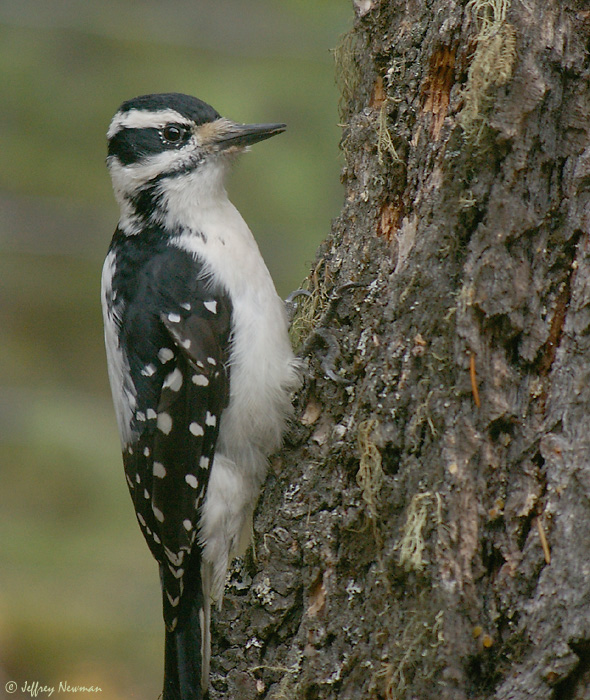
Big-beaked Hairy Woodpecker

I'm no bird expert but for 12 years I've been watching and photographing the birds in my (Cariboo) back yard. Among our most frequent visitors are the hairy woodpeckers. I'm not sure I could tell one from another, except that the males have a red flash on their crown.

So, when I saw this one, I did a double take, thinking it was probably a variety I'd never encountered. But other than a beak three times as long as all the other Hairy visitors (see inset), he was the same. Nothing like this in the bird guide and our local bird guy, Tom Godin, agreed.


He's a regular visitor, gets on well with the other Hairys and seems to manage OK with his long beak. I think he even has a bit of an advantage getting deep into the suet cage, though my impression is that getting food down his beak and into his body is a little more time-consuming.

Have you ever seen a Hairy woodpecker like this? Either way, I'd welcome your comments.

For more about my birds: Birds from a Backyard Deck.

Monday, August 29, 2011

More Wild Cariboo Backyard Plants

I've done more work on the Wild Cariboo backyard plants page and improving it, including the addition of nine new photos.

Corrections, comments etc. very helpful and very welcome.

Here's a bit of a perspective on at least part of the land on which these plants grow:


Monday, August 22, 2011

Wild Cariboo backyard plants

I live on less than an acre. About half of the available land is second growth interior Douglas Fir. We moved here 12 years ago and, other than building a raised bed garden on the sunny side of the house, I planted little else. I put my energy into a much needed clean-up, including removal (to our wood-stove) of usable wood and excess forest floor fuel. I also removed a pile of thistle and some high-standing weeds.

When the garden was in reasonable shape, I spent more breaks from work walking around or just sitting and observing. After a while (about a year) I felt confident enough to make a few minor interventions - like building a small retaining wall. Mostly, though, I wanted to see what this little piece of land had in mind.

As I became more aware, my senses educated, I saw many changes and discovered the great diversity of plants in this unspectacular piece of land. I had to be careful not to bore people with what I realized might seem trivial to them.

It was relatively easy to get to know the birds that visit us, especially after I bought a fairly good camera. The plants were another matter. The photos I took allowed me to enlist the help of friends/clients in identification - like Chris Czajkowski. One day, I thought, I'll publish a list of the plants that grow here. It's about ten years but that day is dawning. I've just completed my page of Cariboo Backyard Plants with the beginnings of the list: photos of 26 plants. I'll be adding more as I go along.

I'd appreciate feedback and corrections.


Click to go to this web page

Monday, June 27, 2011

Birds from a Cariboo Deck No.11: Hairy Woodpecker


Looks similar but is much larger (around 9 inches) than it's smaller version, the diminutive (around 6 inches) downy. An early lesson in my birdwatching: "Huge Hairy, diminutive Downy".

Spring brings the Hairy woodpecker pairs out, chasing each other in spirals around the Douglas fir. As the young grow into their adult plumage, you can still see the adults feeding them from time to time.


Sunday, January 02, 2011

Harper restrained by environmentalists

Murray Dobbin in The Tyee, points to the ability of sustained and strong resistance by environmental coalitions to keep Conservative economic single-mindedness in check. For example:
The rejection of the B.C. Prosperity copper-gold mine proposal and the saving of Fish Lake was a good example. Approving the mine in the face of very effective publicity on the part of opponents proved just too much for even Stephen Harper to pull off. Defying many of the pundits' predictions, the Conservatives backed off and actually listened to their own environmental review panel.


Now comes a bigger issue:  The Enbridge Northern pipeline plan:
It's a huge issue. Harper has invested a lot in supporting the project. But the opposition is formidable: an informal alliance of some half dozen environmental organizations, 61 First Nations, and many municipal governments that may well be unprecedented. Eighty per cent of British Columbians are opposed to allowing oil tankers in coastal waters. If Harper gives a green light to the project he will unleash an enormous backlash, and the movement which is now simply campaigning for a rejection of the project by a federal joint review panel will move into higher gear, including civil disobedience.
It would be a public relations nightmare for the Harper government. Enbridge, which between 1999 and 2008 had 610 spills releasing 132,000 barrels of oil, is now pumping dirty oil allied with Alberta's Harper. This against a diverse alliance who want to save the pristine wilderness, B.C. coastal waters and First Nations' livelihood. That alliance also has the backing of all the opposition parties, two of which have put forward private members' bills trying to ban oil tankers (an informal moratorium now exists).
Read more

The Campaign to protect Fish Lake 

Sunday, October 17, 2010

Chris Harris tours to launch his new book: Motherstone

Coming soon to a venue near you (if you live in BC, that is).

Motherstone: British Columbia's Volcanic Plateau - by Chris Harris

MOTHERSTONE
British Columbia's Volcanic Plateau

In the high country of British Columbia's Central Plateau lies the Motherstone. It is a land that few people have walked over or seen before. It includes a chain of shield volcanoes formed over a mantle hot spot rising from a depth of 2,900 kilometers, a sea of crystallized basalts stretching 300 kilometers from Anahim Peak to the Painted Chasm, a river of obsidian, underwater volcanoes sitting high up above the world's only inland temperate rainforest, and a field of cinder cones still rising from among the trees they burned through when they were formed.

Tour Itinerary


Friday, October 01, 2010

Beetle-killed trees probably less flammable than green trees

NASA Satellites Reveal Surprising Connection Between Beetle Attacks, Wildfire
The results may seem at first counterintuitive, but make sense when considered more carefully. First, while green needles on trees appear to be more lush and harder to burn, they contain high levels very flammable volatile oils. When the needles die, those flammable oils begin to break down. As a result, depending on the weather conditions, dead needles may not be more likely to catch and sustain a fire than live needles.

----------------------------------------------------------------------------

For some years Dave Neads has been pushing this point. Perhaps it takes an authority like NASA to get past the sceptics and vested interests. In 2004, in his series, The Other Side of the Story, he wrote:
On the bright side, once the trees are dead, they actually are less of a fire hazard than the green tree that used to stand so prettily in your garden. This is because all those oils and turpentines have left the tree needles, and they are actually not as prone to explosive crown fires as green trees.
One they reach the gray stage, they are very low risk for naturally occurring fires, but once felled, these naturally air dried trees make good firewood, so there may be a bonus if you have several of them on your property.
From Backyard Beetles by Dave Neads

Other posts by Dave Neads:


Dave's personal blog: Chilcotin Ark