
. . . and their reporter replies to his letter.
Read the story
. . . and their reporter replies to his letter.
allows anyone with internet access and $25 to acquire a miner's license and then, at $0.17 an acre, buy mineral rights to land. It doesn't matter whether that land belongs to a neighbour, the Crown, or the "miner" himself. Once you own the mineral rights, you are free to "explore" your claims, wander the property, "poke at a few rocks," in the words of MP Tom Christensen. And once you decide to start drilling and digging, even the landowner's dwelling and buildings are at risk.
Will one of Canada's most endangered ecosystems receive National Park status?
by Heather English
The Dominion
 Put a camera in the right hands and a new world opens up for a lot of people. Chris Czajkowski has had a digital camera for a few short months and already she has generated some striking images of her world in the Chilcotin wilderness of BC. Many wilderness lovers know her through her books and slideshows. They will be delighted at this more expansive view of her world, presented though her online Photo Journal. For those who don't know Chris, this is a very good introduction to her and the world she knows and loves.
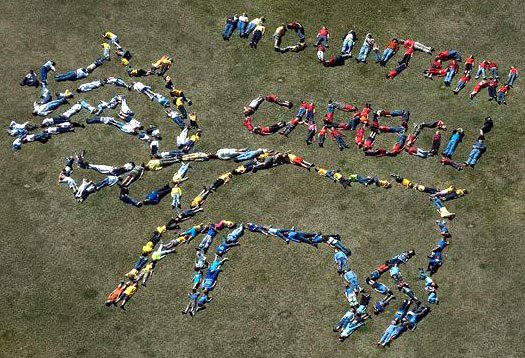 Nearly 200 students, teachers and parents from Lindsay Park Elementary School in Kimberley, B.C., bent and stretched their bodies to from a 100-foot mountain caribou to help raise awareness for this critically endangered species. Fewer than 1600 mountain caribou remain in the world, almost all of which live in B.C.. The Purcell herd near Kimberley has dwindled to fewer than 20 animals in recent years.
Biologists who have been studying mountain caribou in B.C. for 20 years expect several of the small groups will disappear soon. The biggest herd consists of about 525 caribou, and it is considered relatively stable. But the rest are pretty much on their way out - unless a government caribou-recovery strategy that is expected to be finalized this fall can save them.
By terry glavin

Although it once thrived, the Interior Fraser coho may soon be forced out of the world’s fast-dwindling inventory of living things. Ernest Keeley photo.
This is the way the world ends. Not with a bang but with decisions. The decision that this column is about is buried deep within a 6,916-word “regulatory impact analysis statement”, a document with the misleading title “Northern Bottlenose Whale (Scotian shelf) and Channel Darter Protected Under the Species at Risk Act”. It appeared quite suddenly on an obscure federal public-registry Web site, at the very end of the business day in Ottawa, on Friday, April 7.
What was hidden in that document was Ottawa’s decision to withhold the protection of the Species at Risk Act (SARA) from a critically endangered species known as the Interior Fraser coho salmon. When the Campbell government, in breaking one of their main election promises, sold BC Rail, most of us in the BC Interior were sad and angry . . . We didn't know how bad it was going to get: on top of the loss of our local rail company, we now seem to have a bunch of incompetents running the line. Probably we all underestimated the work and know-how involved in taking trains along that challenging line - but CN! As Andru McCracken says in an article in The Tyee.
you need people to operate these trains. You need human beings, capable of all manner of thought and observation to deal with problems that arise on a rail line.Whatever the reason (most likely cost-cutting to increase profits), we've had a string of accidents - spills (of varying toxicity), damaged bridges - that shows no sign of ending. This despite the fact that train length has been curtailed by the BC government (at a time when rail capacity is sorely needed to take some of the strain off our highways, burdened by beetle-kill logging trucks).
 For a more in-depth consideration of the dangerous rail line we now have, read McCracken's article. Meanwhile, for our own protection let's keep our eyes open and the spotlight and pressure on CN, which seems to be attempting to hide and minimize the damage and danger they are responsible for. In McCracken's words:
'Thank God it was grain,' I whisper to myself when I see their contents strewn meters from open water. Later, during my interview with Jim Feeny, one of CN's communications people, he briefly asked how I managed to get to the site. It was a telling question. On my own watch, CN's remoteness and their ownership of the rail corridor has protected them many times against the prying eyes of the media.
This is devastating for families like ourselves who live beyond cable connections and who canÂ’t afford or don'’t wish to install a satellite system.CBC has made available a list of where their programming is available in the affected areas - at least most of them. No word there about our neck of the woods: 100 Mile House - Williams Lake.
Diether urges television viewers in similar circumstances to contact CBC BC Programming, Comments and Questions at 1-866-306-4636.


