Monday, August 29, 2005

Is the log cabin a good symbol of BC?

As a local, I'm kinda proud of this success story, but the point made here, though a little tongue-in-cheek, made me think (now there's an achievement!)

BC's Global Symbol? The Log Cabin


BC Canada House under construction at Sitka Log Homes

At Turin Olympics, that's our contribution to 21st century architecture.

By Helena Grdadolnik
Published: August 26, 2005
TheTyee.ca

British Columbia will be represented at the 2006 Turin Olympic Games by a log cabin. I suppose we are not sending an igloo because it would melt?

Read on

Wednesday, August 24, 2005

Eating Local: The Hundred-Mile Diet Goes North

Two Vancouverites have been making a serious and fairly successful attempt to eat local. They call their approach The 100-Mile Diet because their rule of thumb is to eat only food that is available within 100 miles of where they live.

Recently they took a daring step: they moved north, filled with trepidation that the unsophisticated wastes of the Interior would yield little that was palatable. Of course, they were wrong.

The Hundred-Mile Diet Goes North

Wish you were here
By J.B. MacKinnon and Alisa Smith

Published: August 23, 2005

TheTyee.ca

To be honest, we thought we’d cut ourselves some slack. We were going to northern British Columbia, for god’s sake. We could hardly be expected to stick to some monkish vow to eat only those foods produced in a hundred-mile radius. Environmental sustainability would, like us, be taking a summer holiday.

Read on

Saturday, August 20, 2005

BC loses control over its resources

In case you hadn't noticed:
Last week in British Columbia, in the biggest foreign takeover since the 2002 buy-up by South Carolina's Duke Energy of Westcoast Transmission, Texas-based Kinder Morgan picked up Terasen -- B.C. Gas before it was privatized -- the province's largest natural gas distribution company and the biggest private sector provider of water services in Western Canada.
Read the rest

Thursday, August 18, 2005

Planning for when the pine gets scarce.

Many are warning about the need to plan for 10-15 years from now when the currently busy mills begin to close because there is not that much pine around any more. One place you don't hear much of this line of thinking is in government. I guess they only have to think four years ahead.

You will not be surprised therefore to hear that this article is not written by a someone in government.

Let's Grow a Pine Beetle Fund


Pine beetle damage

BC must invest now to stave off beetle crises in the future.

By Ben Parfitt
Published: August 17, 2005

TheTyee.ca

Timelines in forestry are long, far longer than election cycles, which is why governments of all political stripes are often reluctant to invest in reforestation.

There's a danger in such thinking, however, because it causes us to lose sight of where our forestry dollars end up. In British Columbia, forestry related activities fund many of our public services. For that reason, nurturing our publicly owned forests makes a lot of sense. By investing in them today, we set the table for a more secure tomorrow.

Unfortunately, such investments are not being made. And continued failure to do so ensures great hardship for Interior communities in the years ahead.

Read on

Wednesday, August 03, 2005

Factory fences: aliens in the Chilcotin

This is a guest post from Dave Neads who plays a number of roles including those of president of the Cariboo-Chilcotin Conservation Society and member of the BC Ministers Community Advisory Group on Mountain Pine Beetle.

ALIENS IN THE CHILCOTIN

They go on for miles and miles. Evenly spaced alien footprints on an ancient land. Posts neat and straight, all the same height, the spoor of factory fences is appearing everywhere in the Chilcotin Cariboo.

The most recent manifestation of this otherworldly phenomenon is along Highway 20, just up on the flats west of Barr Hill. Beneath the new telephone poles, running in a trench scraped by a cat, the barbed wire fence glistens in the sun, its razor edges there for all to see.

Well, not for all to see. Further west, just outside of Nimpo Lake there is another factory fence. It was built in the mid-nineties, just about a decade ago. The wire is sagging, the poles are leaning, and there are sections where animals have become tangled and torn the wire free of the poles.

In one ten mile stretch you will see dozens and dozens of places where once red flagging tape still exists, wrapped along the top wire. These were put there by Ministry of Environment people when we still had Ministry of Environment people who were employed and actually went out on the land.

The purpose of the ribbons? They marked the top wires that were covered in moose hair or bits of hide where the animal had tried to jump the fence, but for whatever reason, had miscalculated or perhaps been caught in the snow - but the fact is, some of the critter was left behind on that barbed wire.

These ribbons give mute testimony to the failure of barbed wire to be friendly to wildlife.

Yet, here we go again, building miles and miles of barbed wire fence on costly green poles along Highway 20. Why?

Well, we are told, it is cheap to build, easy to maintain and lasts a long time. Look at those nice pretty green posts, full of those nice chemicals, look at the miles of shiny new wire, its cutting edges sparkling in the sunlight. What could be better than that?

Logs, that's what. Traditional log fencing. We have more dead trees than we can handle in the Chilcotin. We have people who need work, including horse loggers and others who are willing to handle fencing contracts. The moose, deer, horses and other animals who get hung up on, cut by and clotheslined with barb wire sure don't think it is a good idea either, all those miles and miles of barb wire on a once safe range.

As to the cost, maintenance, and longevity issues, the fence further west gives lie to that argument. It is a perfect test case. On the west side of the highway stands a log fence and on the east side stands (sort of) a factory fence. Both were built at about the same time.

As you drive along switching your gaze from one to the other, it soon becomes clear that the log fence is actually in better shape than the factory fence. It still stands proud and strong, a testament to the men who built it, to the men who were paid wages with which to buy groceries and feed their local families, using environmentally friendly local materials, which will last twenty to twenty five years before they need to be replaced, before they will become firewood or habitat for insects and other wildlife. And that fence doesn't skin or kill any horses or wildlife.

Contrast the factory fence, sagging and falling over, wire busted and tangled where it has maimed or maybe even killed horses and moose and deer.

When the full cost is considered, not just the narrow bottom line of the project, log fences are the big winners. We don't need factory fences made with chemicals and steel that were produced by processes located in factories thousands of miles away. These factories use non-renewable resources, belch greenhouse gasses into the air and make profit for corporations and their shareholders in distant lands.

We need fences that serve all, we need fences that are esthetically pleasing, environmentally sustainable, provide greater local employment, are wildlife friendly and which are, in the end, the best and cheapest option available. We need log fences, not alien factory monsters marching lockstep across the land.

Dave Neads

Friday, July 22, 2005

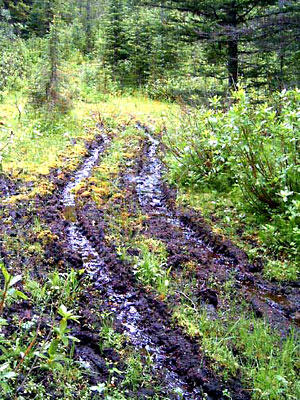
Wilderness Abuse - Off-road vehicles and riders destroy alpine trail


With increasing damage of delicate trails and wilderness areas by off-road vehicles, there is a growing move to require licensing and more control. Fortunately most of the main interest groups are working on this together, as there is great sensitivity, on the part of many snowmobilers and ATVers especially, at having their "freedom" curtailed. For an example of what the fuss is all about, take a look at Wilderness Abuse.

Thursday, July 07, 2005

Organic food: corporate vs local

As mentioned in the previous post, it's tough to compete against subsidized food, especially when you live in smaller population centres and have to get your produce to market. Now, the small organic growers are up against a growing corporate organic sector. To get the picture, take a look at the current chart of "who owns what".

If you are looking for food grown with care, these days the organic label is no guarantee. In my opinion, and for many other reasons, local is the way to go: buy from people you know or at least people you can talk to. This is why I built a web page for South Cariboo Produce, locally grown or raised food. Here are some of the reasons why buying local, whenever possible, makes sense:
  1. Produce is fresher
  2. Fruit which doesn't have to travel can be picked riper
  3. Fuel/transport costs will inevitably increase as our fossil fuels become scarcer
  4. Supporting local food supplies now will enable them to be there in the more challenging days to come.
  5. Reduce pollution by reducing transport distances
  6. Keep your money local, thereby supporting and building your community.
If you live in the BC Interior and would like a similar page, I would be willing to put it together at no charge, using information you provide. Go to JN Web Design and e-mail me from there.

Wednesday, July 06, 2005

To the USA: Pull in Your Horns a Bit

A letter in response to a Macleans article by John Gibson
Reprinted with permission
-------------------------------------
Mr. John Gibson, Fox News:

In reading your comments about Canada in your article in MacLeans Magazine I wondered how a newsperson with all of the resources you must have for in-depth research could have written such a shallow, cliché-ridden article.

I am a rural Canadian, living six hours drive from the nearest large city (Vancouver). I live in a community that depends on forestry, agriculture and tourism for its economic well being. That means that your comments on mad cow and softwood lumber bear some thought. As well your overall tone of sarcasm deserves a response.

First you must understand that every Canadian is always aware that we rarely appear on America's radar screen unless America sees a major advantage. Softwood lumber and agriculture are a case in point. When America wanted the North American Free Trade agreement it was fiercely negotiated on all sides but in the end was determined by the American negotiators. However, your lumber interests were not prepared to see softwood lumber part of an open free trade, hence the softwood lumber agreement. Once that agreement was up for renewal your industry and government deemed Canada an unfair competitor and heavy duties were placed on shipments to the USA. The only people who have really suffered is the American consumer. But, what really burns those of us who live in rural Canada is that, at every court challenge, America has lost and has simply refused to accept the rulings, even those where American members of the tribunal were in the majority.

When your government, after much careful investigation and with the full cooperation of Canada, decided to lift the ban on Canadian cattle you found a way through the courts to stop the lifting.

What we have learned from these particular actions is that there is no way of winning when you deal with America. The rule of law for you simply highlights the need to find or write a new law.

And dare I mention agricultural subsidies? Yesterday we bought apples in our local store that are a product of the USA. They were cheaper than Canadian apples simply because of your farm subsidies.

Your little excerpt from your book 'Hating America, the New World Sport' does not include any Canadians I know. None of us hates America. Most of us have friends and often relatives south of the 49th parallel. But we are a nation one-tenth your size in population (in fact the population of California is greater than Canada's). We are wary of you. Canada has only been invaded by a foreign power twice in our history, both times by the USA. We know that the minute you deem it in your national interest to need our water or oil that you can come and take it.

You see, as the 'New Roman Empire', we have to be wary and sometimes this may come across as being angry or jealous or any of the other adjectives you used. America has demonstrated many times in recent years that its interests supersede everything, including national sovereignty.

So pull in your horns a bit. We don't hate you; we aren't jealous; we're careful. To misquote one of our politicians, sleeping next to an elephant makes one careful.

Sincerely,

Jack Witty
108 Mile Ranch, BC

Monday, July 04, 2005

Review of the state of mountain pine beetle in BC

I think this is a fairly balanced analysis of the pine beetle situation:

The Tyee: What a Black Beetle Can Teach Us


A dead sea of red. Lorraine Maclauchlan photo, B.C. Ministry of Forests


Mountain pine beetle–infested timber is helping B.C. boom. Will we learn the bug plague's lessons before the bust?

By Jared Ferrie, July 4, 2005

As mountain pine beetles continue to munch their way through B.C.'s forests, logging companies are ramping up operations in order to harvest the millions of hectares of dead trees left in their wake.

Read on