Friday, March 16, 2007

Don't bring apples - and the apple maggot - home with you.

If we who who live in the Interior and visit the Lower Mainland and points south, are very careful, we can play a part in delaying the arrival of the apple maggot in the Okanagan. The simple request of vulnerable apple farmers in the Okanagan valley and other interior BC apple-growing areas is: Don't bring back any apples. This delay will, at least, give growers a little time to prepare. The little beast is already established in the Lower Mainland amongst the apples and crab apples. According to a Ministry of Agriculture entomologist, quoted in an article in the Vancouver Sun,

The southern Interior of B.C. is the only apple-growing region in North America that is currently free of apple maggots . . . It made its way [across North America] from the eastern U.S., where it originated. Once the insect establishes itself in the Okanagan, countries that import Okanagan fruit could impose trade restrictions.

Thursday, February 22, 2007

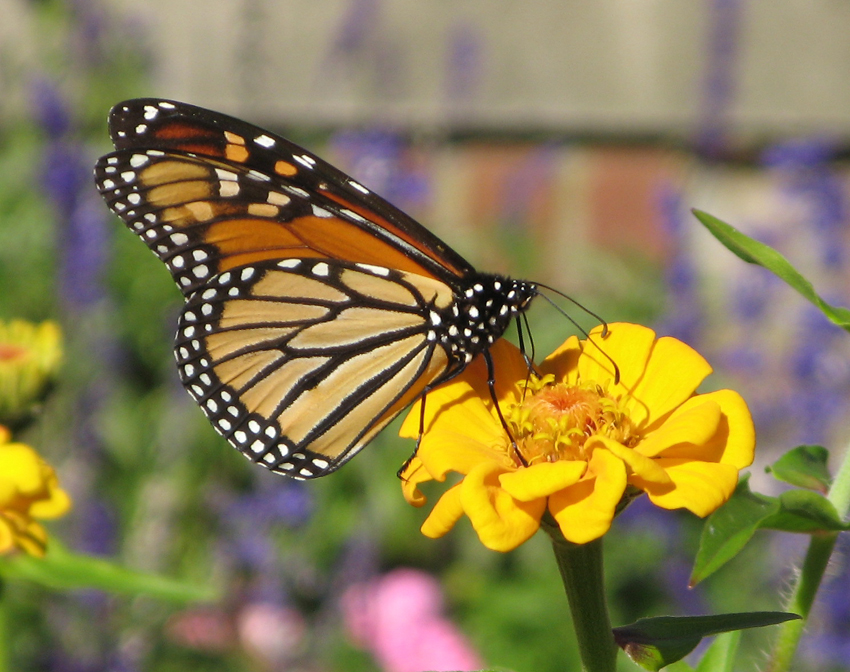
Help Save Monarch Butterflies

Photographer made this available under a Creative Commons License

On this side of the continent, we have the western Monarch and it seems that both eastern and western varieties are under threat because of massive loss of habitat brought on by modern farming methods, especially the use of Roundup Ready corn and soybeans.

So, the call is out for individuals anywhere in the monarch range to provide what they can by way of "way stations" for these exceptional migrators.

Some Insects of the BC Interior: Text and pictures.

Saturday, January 06, 2007

Kettle Valley farmer tries to stop radio-active mining on his land

A Rancher's Radioactive Hell

Joe Falkoski says he's being forced by bad laws to allow toxic mining on his land.
A special report By Kendyl Salcito
January 4, 2007

Falkoski with barite chunk at prospecting site left barren.

TheTyee.ca

What do you do if you are a rancher told by a company -- and then the courts -- that there is nothing you can do to stop your rangeland from being dug up and further strewn with radiation?

Read on

Friday, December 08, 2006

Wildfire in the Wilderness by Chris Czajkowski

Alarm about the 2004 Lonesome Lake fire went unnoticed for a while, to the great frustration of locals. It prompted me to start a blog and bring attention to the fire with reports from locals. Some of my friends and clients (I design web sites) were in the midst of this drama and their personal accounts were vivid, leading, amongst other things, to me getting a call from the CBC asking for information. Once the fire grew in size it had no trouble getting attention. Amongst those in danger was Chris Czajkowski, pioneer log cabin builder, botanist and wilderness tour guide. She was sending me regular reports which I reproduced in my blog and then on her web site. This year she published her account of this dramatic experience: Wildfire in the Wilderness

Nuk Tessli - Photo © Katherine StewartThe book culminates in a white-knuckle account of the all-too-close Lonesome Lake fire of 2004, from its infancy as a lightning strike reported in nearby Tweedsmuir Provincial Park, to Czajkowski's realization that her first wilderness cabin had been consumed by fire and the dreaded moment when she is ordered by radiophone to evacuate herself, her guests and her dogs.

This latest book from Chris Czajkowski's spectacular corner of the world is another engrossing account of life in her wilderness. She regales the reader with accounts of shimmering mountain peaks, roaring snow-fed creeks, bears, eagles and monstrous storms; and tales of her dogs - Bucky (short for Bucket-head), who chases everything; Max, who tussles with wolves and a porcupine; and Raffi, a large, happy animal who thinks he's a lapdog.

Saturday, December 02, 2006

Two new books on the Bowron Lakes

NEW (March 2007): These books now have their own web site, along with other information: www.canoebowronlakes.ca

BC photographer, Chris Harris, has published nine books. His two most recent bring to us his longtime experience on the Bowron Lakes.

The Bowron Lakes, British Columbia's Wilderness Canoe Circuit - A Lifetime Journey features 150 of his photographs in a generous 10.5" x 10.5" format. The images are augmented by information and archival material outlining the natural and cultural history of the Bowron Lakes.

The Bowron Lakes, British Columbia's Wilderness Canoe Circuit, A Lifetime Journey
Here is a photographic record of a man's discovery of his self in the deepest wilderness. Out of the physical and emotional challenges of more than 100 trips through the Bowron Lakes and the wilderness around them, alone, in the company of close friends, with large groups of clients, and even on skis in winter, Chris Harris has redefined his relationship to wilderness and photography. The Bowron Lakes: A Lifetime Journey will change yours. Its transformative combination of images and shared thoughts and stories is a gift brought from long exploration and deep reflection and contemplation. Land, water, light, animals, and the journey itself, are presented here as none have done before. - Harold Rhenisch
For those who plan to experience these lakes first-hand, Chris has recently published a guide book to the Bowron Lakes.
It will answer your questions about bears & wildlife, campsites & fires, trip preparations, portages, weather, reservations & registration, natural & cultural history of the area, and what canoe and wilderness experience you'll need to enjoy your trip. - from the web site.
The Bowron Lakes Guide Book

Friday, November 24, 2006

The Alcan question: aluminum or hydro?

Konrad Yakabuski in The Globe & Mail takes an in-depth look at the background to this story . . . which started when
In 1950, British Columbia's government gave Alcan the right to reverse the flow of the Nechako River, flood 125,000 acres of land and displace about 200 members of the Cheslatta nation so that the company could build the 900-megawatt Kemano station. The electricity was meant to supply Alcan's Kitimat aluminum smelter, located some 80 kilometres away and boasting an annual capacity of 277,000 tonnes.
Since then there has been much water through the turbines:
Things were still humming in the late 1980s, when Alcan won the approval of B.C.'s Social Credit government to build a $1.3-billion addition to Kemano—increasing power capacity by more than half—on the understanding the company would eventually build a much larger smelter to use the electricity and create hundreds of jobs in Kitimat. Sadly, this is where promises began to be broken and Kitimat's once-bright future—it was designed for 50,000 people but is home to fewer than 10,000—began to dim.
The rest of the story

Thursday, November 16, 2006

Provide shelter for winter birds: Chickadee

Those of you who've seen my Backyard Birds page will know of my interest in the feathered flyers. Winter - a tough time for birds - is almost upon us and here's something you can do to help them along:

Give Shelter to Wintering Birds

And, as No.2 in my Cariboo birds series, here's a common bird that will benefit from your assistance:

Birds from a Cariboo Deck
No.2 - Black-capped Chickadee


Sunday, October 29, 2006

Birds From A Cariboo Deck. No.1: Steller's Jay

This is the first in an occasional series featuring photographs I've taken of birds that visit my Cariboo back yard. It seemed appropriate to start with BC's provincial bird, the

STELLER'S JAY


The Steller's Jay is an occasional visitor but this year has decided to stay a while. It's now around two weeks and he/she is still here, filling up regularly with sunflower seeds, water and a little suet.

More Birds from A Cariboo Deck

Tuesday, October 24, 2006

Record low levels in many Interior rivers

The BC Ministry of Environment's River Forecast Centre reports record (50-100 years) lows for many BC Interior rivers. These include:
  • most gauged rivers in the Peace
  • Fraser River at Hope
  • Fraser River at Prince George
  • Thompson River at Spences Bridge
  • North Thompson River at McLure
  • Coldwater River
  • Eagle River (at Malakwa)
  • Salmon River (at Salmon Arm)
  • Quesnel River
  • Bella Coola River
  • Saloomt River (at Hagensborg)
  • Tulameen River
Most of the BC interior is approaching freeze-up, with night-time temperatures now falling to below freezing at many of our snow pillow sites. If significant rainfall does not occur in the next three-to-four weeks, precipitation may occur as snow and rivers will remain at their low levels for the duration of the winter.

The Pacific Northwest is currently experiencing mild El Nino conditions, with a resultant tendency for warmer than normal and drier than normal conditions for the autumn and winter.
The Fraser River running through the central Cariboo
Photo JN Web Design

Thursday, October 19, 2006

Perspective on the Lodgepole Pine

Dave NeadsGuest article by Dave Neads, director of the Cariboo Chilcotin Beetle Action Coalition and of the Cariboo Chilcotin Conservation Society. He is a member of the Cariboo Chilcotin Regional Resource Committee, represents the West Chilcotin Tourism Association regionally and writes a bi-monthly column on conservation issues for the Williams Lake Tribune.
------------------------------------------------

Survivor

The Lodgepole pine is an amazing tree. You can find it at sea level and on the backside of the coast mountains huddled against boulders at 6500 feet. One species, one adaptation, capable of living in this huge range of habitats.

That is what survival is all about, having the genetic options available to adapt to a huge range of conditions. We are all familiar with the coastal rain forests and the way they are promoted as havens for biodiversity. We're always reading about how many species there are per hectare, how many tonnes of biomass per cubic meter are produced.

The same is true of the tropical rainforest. The Amazon Basin is touted as a global hotspot, an area of such significance that it must be protected; must be treated differently because of its wealth of diversity.

While all of this is factual, it is only valid in times of relatively constant climate parameters.

The one thing these rainforests cannot tolerate, the one thing that kills them permanently, is a large scale shift in either water or temperature regimes. Because of this, these rainforests, whether tropical or temperate, actually occupy very restricted niches in the global ecosystem and are intolerant of any real shifts in the climate that supports them.

We are approaching times of instability, times of large shifts in climate, of large shifts in habitat structure and availability. The gene pool needed to cope with this milieu needs to be robust, adaptable and capable of living under a wide range of conditions.

The interior dry pine forests are a excellent example of the gene pool needed in the coming turbulence of climate disruption. These trees already have the ability to grow in wet warm places on the windward side of the mountains while at the same time thriving in the dry valley bottoms in the Fraser Canyon and on the highest tree line patches on the western edge of the Chilcotin Cariboo.

Such resilience is what needs to be respected, what needs to be set aside. The Mountain Pine Beetle is selecting out a huge percentage of the pine in the region of its interior habitat. When this process is done, the trees that are left will have the resilience to the beetle combined with the already acquired traits of survivability over a broad range of forest habitat.

This is the kind of gene pool that will survive; one that is strong, hardy, able to withstand the coming shocks. Now more than ever, as climate change marches across the globe, it is necessary to leave large areas of temperate interior dry forest intact. It is these areas that will provide the genetic reservoirs for the next generation of forest communities that will inhabit the region.

These trees that we take for granted may not be hundreds of feet tall, they may not be good pin-up material, but our interior dry forests are far tougher, more adaptable and vigorous than their warm climate cousins who will not survive a major shift in their habitat. We must make sure that we set aside areas where the the pine forests of the Chilcotin Cariboo can recover from this beetle and survive in enough numbers to blaze the evolutionary path in the coming decades.

- Dave Neads