Wednesday, July 05, 2006

Anahim Lake area fires, 2006

Once again the Anahim Lake area is threatened by fire. I have a number of friends and clients in that area and am attempting to keep in touch with the situation. There isn't a lot of information available in the media. This is how it was last time there was a large fire in that area - in 2004. At that time I carried reports and pictures from people I knew who live in the area. It might be time to do that again. If you have reliable information on this fire, contact me via the Inside BC web site.

Meanwhile, here's what I've come up with at this point:

July 4: The forest service is also battling a wildfire in the Anahim Lake area which has forced the evacuation of one resident. Five aircraft and 118 firefighters have been dispatched to combat that blaze. - Global National (Canadian Press)

July 4: The largest fire is located 48 kilometers northwest of Anahim Lake by Tezla Lake, and was reported at about 7 p.m. on Sunday. "The largest fire is currently at 150 hectares, and it's considered out of control right now," spokesperson Kim Steinbart said. There are buildings in the area and so far one resident has been asked to keep away from the area because of the air tankers and other firefighting activities. She said that nearly 100 firefighters are on the scene with eight pieces of heavy equipment.- Williams Lake Tribune

This information is provided by the BC Ministry of Forests:

Fire No. Geographic Discovery Date Hectares
C50150 MapQuest 5.5 km N of Tezla Lk Jul 2, 2006 50.00
C50148 MapQuest 2.4 km N of Tezla Lake Jul 2, 2006 9,000.00

Click on the number to get more information and on the button to see the location

Monday, June 26, 2006

Mining Minister Responds to Tyee Story on Land Disputes

. . . and their reporter replies to his letter.

The Tyee is outstanding in its encouragement of discussion and debate. It's encouraging to see a cabinet minister addressing challenging questions (see my previous post) even if Kendyl Salcito's rebuttal that follows is, in most cases, pretty convincing. The readers' comments that follow (below the reporter's comments) are pretty strong too.

Read the story

Thursday, June 15, 2006

BC land-owners vulnerable to prospecting miners

It appears that mining rights to much of BC's land has been bought up - thanks, at least in part, to the provincial government's online staking system. According to Kendyl Salcito in The Tyee, this system:
allows anyone with internet access and $25 to acquire a miner's license and then, at $0.17 an acre, buy mineral rights to land. It doesn't matter whether that land belongs to a neighbour, the Crown, or the "miner" himself. Once you own the mineral rights, you are free to "explore" your claims, wander the property, "poke at a few rocks," in the words of MP Tom Christensen. And once you decide to start drilling and digging, even the landowner's dwelling and buildings are at risk.

Saturday, June 10, 2006

BC Grasslands at risk

Will one of Canada's most endangered ecosystems receive National Park status?

by Heather English
The DominionKobau_sage_web.jpg

The South Okanagan Valley contains more ecological diversity than any other in British Columbia.
photo: Dick Canning


When driving along Highway 3 in southern British Columbia, you’ll find yourself looking out over the South Okanagan Valley; a landscape made up of a mosaic of green, yellow and brown shades, each a different ecosystem. From the bunchgrass ecosystem in the lower elevations to the alpine tundra in the mountaintops, this region contains more ecological diversity than any other in British Columbia. The valley bottoms support more than just ecological diversity; they also support a booming tourist economy, cattle ranching, agriculture and vineyards. The opposing interest groups in the region have made the proposal for a national park reserve controversial and the region’s future uncertain.

Read on

For more images and information on the BC Grasslands, read Chris Harris' Grasslands photo journal.

Sunday, June 04, 2006

New Photo Journal from Chris Czajkowski

Chris CzajkowskiPut a camera in the right hands and a new world opens up for a lot of people. Chris Czajkowski has had a digital camera for a few short months and already she has generated some striking images of her world in the Chilcotin wilderness of BC. Many wilderness lovers know her through her books and slideshows. They will be delighted at this more expansive view of her world, presented though her online Photo Journal. For those who don't know Chris, this is a very good introduction to her and the world she knows and loves.

As her web designer for over five years, I've edited and placed many pictures on her web site but these carry a heightened immediacy. With Chris living off the grid and far from photo-processing labs, this is a classic example of the value of digital technology: high-tech in a low-tech setting.

Chris Czajkowski

Tuesday, May 23, 2006

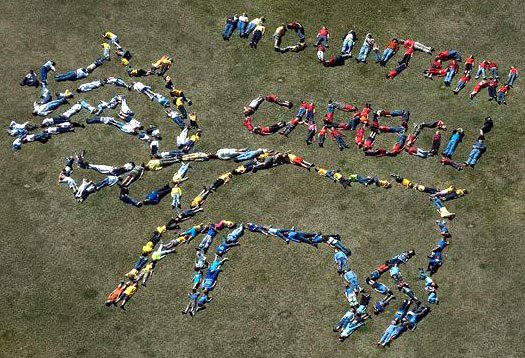
Children form 100-foot mountain caribou

Nearly 200 students, teachers and parents from Lindsay Park Elementary School in Kimberley, B.C., bent and stretched their bodies to from a 100-foot mountain caribou to help raise awareness for this critically endangered species. Fewer than 1600 mountain caribou remain in the world, almost all of which live in B.C.. The Purcell herd near Kimberley has dwindled to fewer than 20 animals in recent years.
Visit www.mountaincaribou.org for more information.

Wednesday, May 17, 2006

A timely review of BC's endangered Mountain Caribou:

Many culprits active in caribou decline - May 15, 2006

Biologists who have been studying mountain caribou in B.C. for 20 years expect several of the small groups will disappear soon. The biggest herd consists of about 525 caribou, and it is considered relatively stable. But the rest are pretty much on their way out - unless a government caribou-recovery strategy that is expected to be finalized this fall can save them.

Complete Globe & Mail article

Thursday, April 13, 2006

Interior Fraser coho salmon abandoned

Cowardly act kills species

By terry glavin

Although it once thrived, the Interior Fraser coho may soon be forced out of the world’s fast-dwindling inventory of living things. Ernest Keeley photo.

Although it once thrived, the Interior Fraser coho may soon be forced out of the world’s fast-dwindling inventory of living things. Ernest Keeley photo.

This is the way the world ends. Not with a bang but with decisions. The decision that this column is about is buried deep within a 6,916-word “regulatory impact analysis statement”, a document with the misleading title “Northern Bottlenose Whale (Scotian shelf) and Channel Darter Protected Under the Species at Risk Act”. It appeared quite suddenly on an obscure federal public-registry Web site, at the very end of the business day in Ottawa, on Friday, April 7.

What was hidden in that document was Ottawa’s decision to withhold the protection of the Species at Risk Act (SARA) from a critically endangered species known as the Interior Fraser coho salmon.

Read the full story in the Georgia Straight.

Tuesday, April 04, 2006

Money for BC Slaughterhouse transition

MEAT TRANSITION: Assistance program

The Meat Transition Assistance Program (MTAP) will provide $5 million to help B.C.'s new and existing slaughterhouses meet the standards under the Ministry of Health's Meat Inspection Regulation by Sept. 30, 2007, the new date for provincewide enforcement. The program has been introduced to increase livestock slaughter capacity throughout B.C. by ensuring there are sufficient licensed facilities to provide livestock producers reasonable access to slaughter services.

Read on

Monday, March 13, 2006

Ongoing string of derailments and damage by CN Rail

Click to see enlarged version of this pictureWhen the Campbell government, in breaking one of their main election promises, sold BC Rail, most of us in the BC Interior were sad and angry . . . We didn't know how bad it was going to get: on top of the loss of our local rail company, we now seem to have a bunch of incompetents running the line. Probably we all underestimated the work and know-how involved in taking trains along that challenging line - but CN! As Andru McCracken says in an article in The Tyee.
you need people to operate these trains. You need human beings, capable of all manner of thought and observation to deal with problems that arise on a rail line.
Whatever the reason (most likely cost-cutting to increase profits), we've had a string of accidents - spills (of varying toxicity), damaged bridges - that shows no sign of ending. This despite the fact that train length has been curtailed by the BC government (at a time when rail capacity is sorely needed to take some of the strain off our highways, burdened by beetle-kill logging trucks).

Click to see enlarged version of this pictureFor a more in-depth consideration of the dangerous rail line we now have, read McCracken's article. Meanwhile, for our own protection let's keep our eyes open and the spotlight and pressure on CN, which seems to be attempting to hide and minimize the damage and danger they are responsible for. In McCracken's words:

'Thank God it was grain,' I whisper to myself when I see their contents strewn meters from open water. Later, during my interview with Jim Feeny, one of CN's communications people, he briefly asked how I managed to get to the site. It was a telling question. On my own watch, CN's remoteness and their ownership of the rail corridor has protected them many times against the prying eyes of the media.